Showing posts with label Silent Film. Show all posts

Saturday, May 12, 2012

Lights! Camera! FIRE!...Plus, A Mistress, A Soul, & A Potion...

(Buster Keaton, with camera)
Recently, I developed an interest in films from the silent era.  It began with a Louise Brooks movie I happened upon while looking through the streaming selections Netflix has to offer.  "Diary of a Lost Girl" was the catalyst film for my new fixation, followed closely by the most current restoration of "Metropolis".  Both are great, and I highly recommend them.  (If you want to see more on those, I have a couple of posts in the 'Silent Film' section under 'Labels' in the right hand side-bar.)

(Mary Pickford, with camera ~
c. 1916)
Surprisingly, the film quality of both is quite good.  Metropolis does have some obvious worn sections that were added after the only known original print was discovered in Argentina.  A few sections of the newly discovered original could not be restored due to extreme decomposition.  That made me wonder just how many of the old films from the late 1800's to early 1900's still exist in a viewable form?  I was shocked to find that the estimation is that less than 20% of films produced during that time have survived.

I was moved to learn more about the actual film stock used in those days. Over the years I have heard a word used when talking about film.  That word is "celluloid".  In a way, I think it is used as more of a slang term for film these days since actual celluloid hasn't been used in many years.  Also called "nitrate" film, it was cellulose nitrate based, and highly flammable.  Projection rooms were required to be flame proof, so asbestos was used in wall coverings.  Talk about a double-whammy for projectionists, and I doubt they were issued hazard pay, either.  Hot projector bulbs were a major threat.  The slower the film speed, the greater the risk of it catching on fire.
    
(Decomposing nitrate film reels)
In 1948, the introduction of a safer product (cellulose triacetate) by Eastman-Kodak, quickly replaced the more flammable film.  By 1950, the nitrate based stock was discontinued.

One site I visited said that a burning reel of nitrate film could be submerged in water, and not get extinguished. Over time cellulose nitrate decomposes, giving off nitric acid which adds to its rate of decomposition.  It eventually turns into a highly flammable powder or a gooey substance.  Needless to say, this makes it extremely difficult for restorers.  Having to 'handle the stock with kid gloves', is an understatement.  I wouldn't be surprised if some restorers need to wear Haz-mat suits.

(Keystone Cops)
Another cause of film degradation is film speed.  There was a loose standard of 16 fps (frames-per-second), and camera men insisted they stuck to that speed, but most films would end up being shot at a faster rate.  Truth be told, most films were shot from 12 to 26 fps.  That's quite a wide window.  Most theater owners didn't pay much attention to film speed, even though all films were accompanied by a cue sheet that might give speed change instruction for certain points in a film. Depending on how popular a movie was, theater owners would want a film to be shown in a shorter time frame, so they could get more butts in the seats. Most silent films weren't shown at the intended shooting speed, so the action would seem rather manic (something I think many people today associate with silent films).  However, there were times a faster pace was used on purpose, comedies mostly (ex: Keystone Cops).


(Slapstick scenes are prime examples of the faster film speeds, these being intentional.)

The cue sheets were also a guide for music cues.  Early theaters played film music live, and most had a piano.  Some of the bigger theaters had organs, and others had orchestras.  The cue sheets would indicate special moods or events in the film that required specific types of music.  Music was either purely improvisational, or repertory.  (The first score composed specifically for a film wasn't until, 1915's, "Birth of a Nation".)  Music selections used could also dictate film speed.

All contributing reasons as to why so many silent films are gone, never to be seen again.  How sad.  Even the best copies we have now aren't perfect.  At one time they were all much cleaner and clearer.  I'm just happy to be able to see the ones I can.  There is something very special about them.  Something that modern movies could never capture, and I hope no one ever tries.   

What follows are three more films I have added to my 'watched' list.  All classic, and all recommended.


I was really looking forward to seeing "Pandora's Box" (1929), a film that Louise Brooks is most known for.  Like "Diary of a Lost Girl", it was directed by Austrian, Georg Wilhelm Pabst, and filmed in Germany.  Apparently, the film wasn't really well received, taking some time to gain some speed.  It would eventually gain Brooks fame.

("Lulu" ~ Louise Brooks)
"Pandora's Box" is a heavy drama, and I think it really showed what acting chops Brookes' had.  In the film, Brooks plays 'Lulu', the mistress of Dr. Ludwig Schon (Fritz Kortner). Schon is a wealthy, and respected newspaper publisher.  The film opens with her being visited by a man she describes as her "first patron", Schigolch (Carl Goetz).  Schon arrives, and breaks the news that he is going to be marrying another young woman, Charlotte von Zarnikow (Daisy D'Ora). An argument ensues, Lulu trying to get him to change his mind.  Schon finding Schigolch hiding out on the terrace doesn't help.  Enraged, Schon leaves.
(Alwa confesses his love to Lulu)
As you can see, it's drama from the start.  We meet Lulu's best friend, Alwa (Francis Lederer), who also happens to be Schon's son, and who is secretly in love with Lulu.  In an attempt to focus her attention elsewhere, Schon gets Alwa to cast Lulu in the musical revue he is putting together.  All seems well until Schon shows up with his fiance on opening night.  Needless to say, Lulu has a fit, and refuses to go on.  Schon tries to talk some sense into her, and she throws a tantrum.  While the two of them are in a loving embrace, Charlotte walks in and the marriage is off.  Schon resigns himself to marrying Lulu.

(A struggle...)
In the remainder of the movie there is plenty of scandal, and nefarious goings on.  Black mail, gambling, prostitution, and a self loathing 'Jack-the-Ripper' type is lurking in the shadows.  A gun, a struggle, and a murder.  Believe me, you won't have time to get bored with this one.  There's plenty of tragedy to go around.  Brooks plays the "innocent" shady lady perfectly.  One moment she's charming and adorable, the next she's manipulating.  Brooks is stunning, and Lederer as Alwa is a nice bit of eye candy.  "Pandora's Box" is a must see for all lovers of film.    

"Pandora's Box" is not one of Netflix's streamers.  I had to wait patiently until it arrived in the mail.  However, the second film of my watched trio is currently streaming on Netflix.  It's based on a well known tale of good and evil, "Faust".


(The archangel & Mephisto)
This is not only a must see for film lovers, those of the artistic mind should definitely see this one.  Very stylized in many respects, Mephisto's garb being one of the most stylized elements. "Faust" (1926), was directed by F. W. Murnau, and filmed in Germany.

As I mentioned, many people know this tale. An Arch-angel and Mephisto (a demon) enter into a bet with one another.  If Mephisto can completely corrupt a devout/righteous man's soul, the Devil will have dominion over Earth.

(Faust (Gosta Ekman), and some villagers)
Faust is an alchemist.  The Devil rains a plague down on the village where he lives, and the villagers cry for help.  Faust prays for the sickness and death to stop, but to no avail.  Feeling hopeless, he strikes a 24-hour long bargain with the Devil during which he will have immense power and the services of Mephisto, but as soon as the sand runs from the hourglass the Devil's pact will end.  Faust uses his new power to help the suffering villagers, but they soon shun him because he can't look upon crosses.

("Mephisto" ~ Emil Jannings, young "Faust",
and "Gretchen" ~ Camilla Horn )
The Devil tempts Faust again, offering him his youth back, as well as earthly pleasures that include his own kingdom. The price?  Faust's soul. The new life loses it's charm, and young Faust returns to his home.  There he falls in love with the beautiful and innocent, Gretchen.

In the remainder of the story there is debauchery, love, and murder.  The ending is bittersweet, but the basic message is 'love trumps all'.  If you are not familiar with the tale of "Faust", I recommend you check this film version out.  If you do know the tale of "Faust", but haven't seen this movie...see it.


The third film is based on the extremely well know Robert Louis Stevenson story, 'The Strange Case of Dr. Jekyll and Mr. Hyde'. 


This particular story has seen many film versions, all with slight tweaks to the over all plot line.  In this version, "Dr. Jekyll and Mr. Hyde" (1920), Jekyll believes everyone has two sides or personalities.  A kind man by nature, he ends up creating a potion that splits his personalities into his good and evil halves.  
(John Barrymore...quite the transformation, huh?)
Jekyll  is portrayed by a member of the Barrymore family acting dynasty, John (Drew Barrymore's grandfather).  Not only is Barrymore extremely good looking, his ability to contort himself into the evil and hideous Jekyll is truly amazing.  In some of the background I read I learned that the beginning section of the first transformation of Hyde into Jekyll was done sans make-up.  Impressive, indeed.

If you have seen more than one of the productions of this story line over the years, and decide to gloss over this as just another Jekyll and Hyde movie, DON'T.  I can safely say that this is the main Jekyll and Hyde film that has really creeped me out.  Barrymore is brilliant.

I'm ending this post with a couple of clips I found on YouTube of a rare interview with Louise Brooks.  


Sunday, April 29, 2012

Metropolis...

(Movie poster featuring "Freder" ~played by Gustav Frohlich, the character the story follows)
The future.  A time that can only be left to the imagination.  After all, the future hasn't happened yet.  Theories have been formed on what mankind can expect in years to come.  Most predictions come in the form of science fiction, a story telling form I love.  An imagination can be a powerful tool, and there are many over the years who have used theirs with wonderful effect.

A silent film I discovered on Netflix started a trend for me.  It spawned a desire to watch a growing list of silent film titles, most of them classics.  "Diary of a Lost Girl", starring Louise Brooks, was the catalyst.  The follow up?  An incredible trip into a future that tells a timeless and well worn tale.  A tale that rings true on a number of levels even today.

(Some art shots of the Metropolis city)
The film is "Metropolis" (1927), directed by Fritz Lang, who co-wrote the film with his wife.  After its initial release, the film was edited of any material deemed offensive at the time.  A couple of restored re-releases of the "censored" version have been shown over the years, the last being the most ideal.  Any and all complete copies of the original production (prior to its censoring) were thought to have been lost, never to be found.  Then in 2008, in an Argentinian museum, a complete original print was found.  It took a couple of years to complete this last restoration, and in 2010 the restored print was shown in a couple of theaters in Germany (where the film was made).  This last restoration is the version that I watched on Netflix.

(The heart of the city)
Critically, viewers seem divided.  Some give props to the art direction of the futuristic society, while being disappointed with what was seen as a simple and predictable story line.  I, however, think the film brilliant. Those bits of film from the original print that could be restored are quite noticeable, the damage of the years being evident.  In the few places where footage was beyond hope, a card describing what is taking place is inserted to keep continuity intact.  None of this detracted from my viewing experience.
("Maria" ~ played by Brigitte Helm)

The artistic quality of the sets.  The expression of the story being told through exaggerated yet heart felt pantomime.  A simple story?  Yes.  However, it's one that 'speaks' in so many ways.  The beautiful 'Metropolis' is a front for a dystopian world. Men of wealth rule the city above, while the poor lower classes pour out their blood and sweat to keep the city 'alive'.  One of the chief characters at the center of the story is Freder, son to the "master of the city".  It is Freder who leads us through the film.  He is quite oblivious to the goings on below, never knowing of the existence of the "worker city", nor the plight of the poor workers.  It is during a visit to a pleasure garden where he is frolicking with what I figure to be prostitutes, when he sees the young Maria.  She has brought a group of children from the bowels of the city to show them what their "brothers" are up to.  Freder becomes obssessed with finding her.  Finding his way into the workers' city, he is horrified at what he finds.
The young woman is Maria.  She is a voice of strength to the workers. The epigram at the center of the films story line, and Maria's mantra:  "The mediator between brain and hands must be the heart!"  We never really know where she came from, or what her "purpose" is other than to empower the workers to stand up for themselves.  She speaks of a prophecy that a "mediator" will come to act as liaison between the workers below and the intellectuals above.  Freder follows workers to a room in the catacombs where Maria delivers her "sermons".  The two meet again, and fall in love.  Maria identifies Freder as the mediator they have waited for.

Transformation 2
There is a peripheral part of the story line involving Freder's father, Joh, and the inventor, Rotwang.  Freder's mother (Hel) died giving birth to him.  Joh learns that Rotwang (who also loved Freder's mother, Hel) has created a robot in order to 'resurrect' her.  The two men watch Maria from above, hearing what the plans are.  A plan is hatched to discredit Maria.  Rotwang chases her down in the catacombs, kidnaps her, and through a scientific transformation gives the robot Maria's appearance.  (The scene of Maria being chased is extremely effective.  Her fear is so strong to be almost palpable.)  Robot Maria is unveiled to the men of the city via an extremely racy dance sequence, the room full of men practically drooling over her.


(If you want to pause the page music, the player is at the bottom of my blog.)

(The robot Maria dances...)
Maria's doppelganger creates chaos above and below.  She has made her mark above in the city by getting the men to lust after her.  Below in the cities bowels, she convinces the worker's to revolt and stop all work. The worker's city begins to flood, the worker's children are all in danger, and the real Maria saves the day.  There is a bit of mistaken identity with both Maria's running around.  In the end the enraged workers get their hands on the evil Maria and burn her at the stake.  Freder's father acknowledges the errors of his ways, and son Freder brings Grot, the foreman of the cities' "heart machine", and his father together.

(The lustful onlookers.)
I hate admitting that until now I had not watched "Metropolis".  It is a piece of film history.  It's message is clear, and yes it is a tale that has been told time and time again. Interesting how the simple message of the film still resonates today.  There are the wealthy materialistic men making all of the decisions/controlling things (I will leave out the intellect aspect as I don't think that's a factor in today's world), while the working classes keep things running with no real acknowledgement of their needs or accomplishments by the aforementioned men.

This creative accomplishment is exquisite.  A science fiction world, a love story, and a social statement.  From the first scene I was pulled into that future world.  Two groups of workers.  One coming off shift, and one going on.  Not a word is said.  Just the musical score, and the illustrative movements of the players on the screen.  Just brilliant.  I don't think I have to say that I recommend this film.  Everyone should see it.  The silent film genre is out there, and we need to keep it alive.

Next film up:  Another Louise Brooks film (probably the main one she is known for), "Pandora's Box".
(Brigitte Helm in the robot suit between takes, sans helmet)
(Joh, Freder's father, meets Rotwang's robot)
Transformation 1, Metropolis post
(The real Maria sounds the alarm in the worker's city)


Wednesday, April 18, 2012

The Images of Silent Streaming...


While perusing the newly added titles that stream on my Netflix account, I came across a film I had not seen before.  One from the silent film era.  I have always had an appreciation for the artistic expression of silent cinema.  I have seen several wonderful works over the years, but there is so much that I have not seen.

The title I found is "Diary of a Lost Girl" (1929), and it stars the stunning Louise Brooks.  I had heard of it many years ago, and had made a mental note to see it at that time.  Several years later, there it was on Netflix...so on my next insomnia riddled morning, I watched it.
Based on the 1905 book "Tagebuch einer Verlorenen" ("Diary of a Lost Girl"), by German authoress Margarete Bohme, it definitely deals with some racy and scandalous issues for the time.  Sexual seduction (it seemed more like rape to me), illegitimate children, prostitution, suicide...heavy subjects for a film in those days.

Directed by Austrian, George Wilhelm Pabst, 'Diary' is the second film Louise made with him.  ("Pandora's Box" is another big film for her, also directed by Pabst. It's next on my viewing list.)  Watching it sparked the desire in me to immerse myself in the watching of more silent films.  I mentioned "artistic expression" before.  The emoting that actors did in those days.  So much needed to be said with the face and the hands, aided with an occasional key card of short dialogue here and there.  Yes, much of it is overly exaggerated. The physical movements rife with emotion. Severe make-up and facial gymnastics of many of the performers.  The world of the silent film actor is a world I find fascinating.  From the first frames of 'Diary', I was pulled into that emotionally dysfunctional world.

**Spoiler Alert**:  I am about to get into details of the films' plot, so if you want to see the film and not know what happens...

("Thymian Henning"~ Louise Brooks)
("Meinert"~Fritz Rasp; "Thymian"~Louise Brooks)
Crowned with her famous Bob haircut, and lovely face, Louise Brooks is great in her role as the young (Brooks was 23 when she made the film) and innocent, Thymian Henning.  The drama begins right out of the gate.  On the day of her confirmation, Thymian is distressed when the housekeeper leaves.  Her father has gotten the housekeeper pregnant, and not long after her departure she (the housekeeper) commits suicide.  Thymian's father is a pharmacist.  His assistant Meinart (played by Fritz Rasp) offers her his shoulder, and promises to explain everything later that night.  Instead he 'seduces' her. (Sadly, sexual abuse was something that Louise experienced in her real life.  At the age of 9, she fell prey to a neighborhood predator. When she told her mother about it years later, her mother would say it must have been Louise's fault, as she must have led him on.)  Thymian gets pregnant, and has the baby.  She refuses to divulge who the father is, but her family reads her diary and finds out.  They tell her she should marry Meinart, but she refuses as she won't marry someone she doesn't love.  Her family gives the illegitimate child to a midwife, and ship Thymian off to a reformatory for wayward girls.  The place is run by a woman who is a real task master, along with her assistant (a man that immediately reminded me of Lurch on 'The Addams Family').

(Thymian collapses)
Cut to Thymian's friend, Count Osdorff.  Proving to not be much good at anything he tries to do, Osdorff is kicked out by his uncle.  Penniless, he goes to see Thymian in the reformatory.  She pleads with him to convince her father to take her back, but he informs her that Mr. Henning has married the new housekeeper, and it is impossible for her to go home.  Instead he helps her, and Erika (a friend she has made in the reformatory) to escape. Thymian's first destination is the midwife who has her child.  She learns that her baby has died.  Thymian wanders the streets, and finds Erika who has gotten a job working in a brothel.  Having no skills herself, Thymian becomes a prostitute.  

(Thymian gets a job, and joins the 'world's oldest profession')
One night in a nightclub, Thymian spots her father, Meinart, and her father's new wife, Meta.  Her father is shocked to learn of her current job, and is pulled from the nightclub by Meinart and Meta.  Three years later her father passes. Expecting that she will inherit a lot of money, she decides to start a new life. She agrees to marry Osdorff for the new identity.  At the lawyer's office, she learns that Meinart has purchased her interest in the pharmacy, and she is now a very rich woman.  Thymian then learns that Meinart is going to toss Meta and her children out on the street.  Not wanting her half-sister to experience anything like what she had gone through in life, Thymian gives the money to Meta.
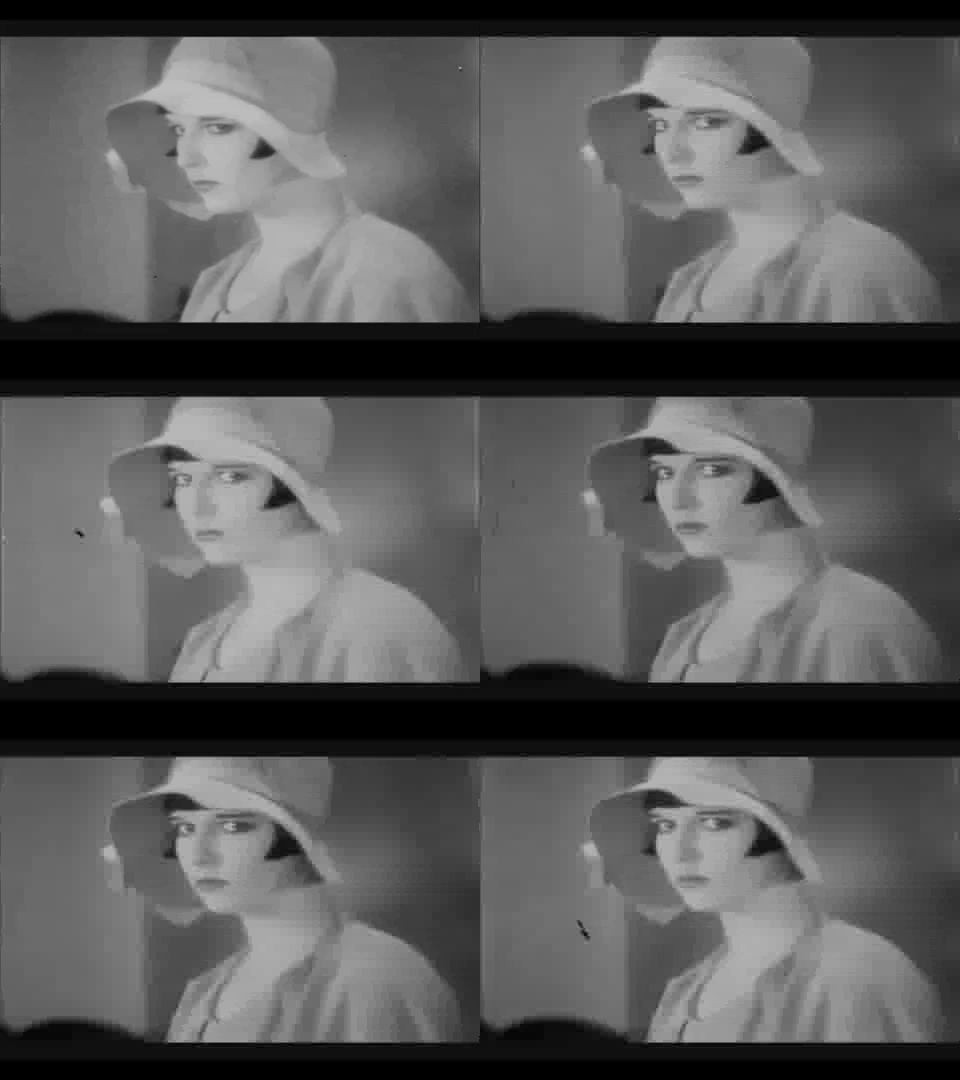


Brooks looking up

Once Osdorff learns of her gift to Meta, he is devastated.  He was counting on the funds to build a new life, as well.  Osdorff commits suicide by throwing himself out a window.  In his grief, Osdorff's uncle does what he can to make amends to his nephew.  He vows to take care of Thymian, calling her his niece, Countess Osdorff.  Uncle introduces her to his cousin, and the cousin invites Thymian to be a director of a reformatory...the same one Thymian had been locked up in.  While visiting the reformatory, the ladies are presented with an "espeically difficult case", who turns out to be Erika.  Embracing her friend, Thymian denounces the reformatory, and storms out with Erika.  It is here that uncle Osdorff says the last line of the film.  "A little more love and no-one would be lost in this world."

As I watched Thymian go through one emotional tragedy after another, I was reminded of what a 'different' experience it is watching a silent film.  A drama. The bulk of what I have watched in the silent vein falls in the category of comedy.  Buster Keaton.  Harold Lloyd.  Both geniuses.  Lloyd actually put himself in physical peril for some of the stunts he executed.  The list of silent drama I have seen is much, much shorter.  Watching 'Diary' has moved me to change the length of that list.

(Thymian sees her father)
What about current generations, and generations to come?  Will the world of silent era films fall by the wayside?  Will a day come when silent films are but a non-existant memory?  I hope not, but television doesn't really show them as much anymore.  AMC (American Movie Classics) doesn't live up to it's name anymore.  TCM (Turner Classic Movies) is a bit better, but there aren't as many "oldies" on anymore.  Yes, I do realize that with the passage of time, what is classified as an old movie changes.  There are a lot more color classics these days.  When I was a kid, the hallmark of an old movie was that it was filmed in black and white.  It is my hope that the channels that call themselves "classic movie channels", make an effort to keep some silent films on the air.  Otherwise, future generations are going to lose out on some special stuff.

If you haven't seen "Diary of a Lost Girl", see it.  If you've got Netflix, it's streaming now.  If you don't know who Louise Brooks is, this is a great introduction to her film work.

If you do watch it, I hope it moves you to watch more silent film, too.

More to come...
