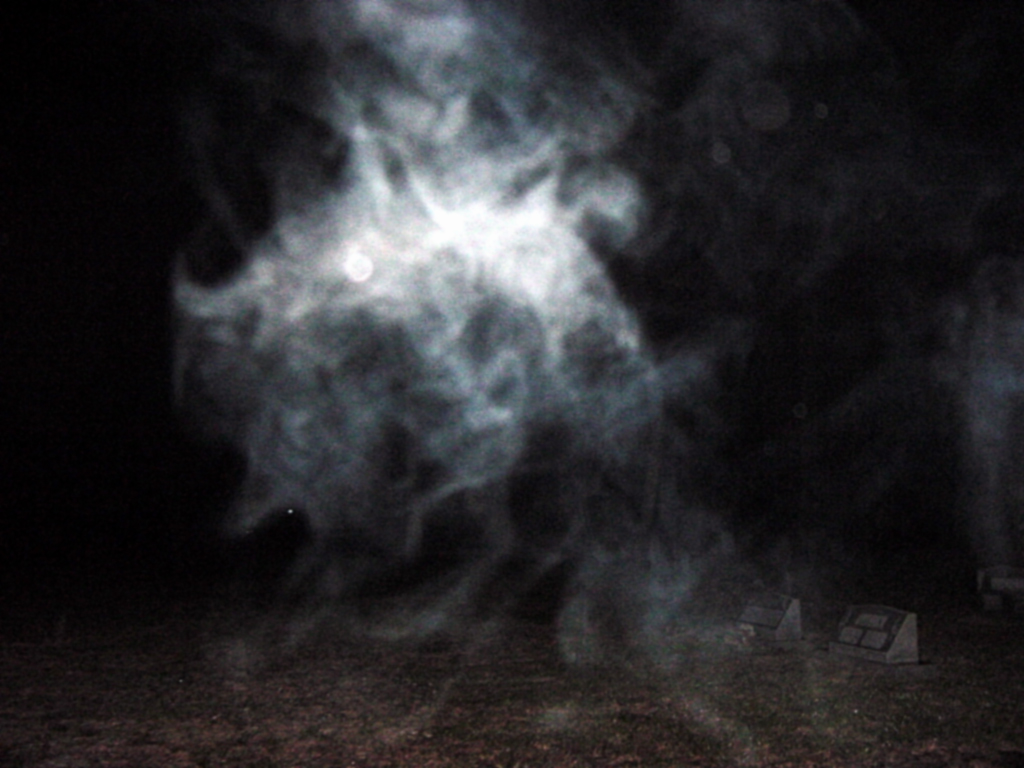
As happens from time to time, I was looking up some stuff on the Internet and saw a picture that sparked my interest. It is the one featured above. (I was unable to locate any info on who the medium is in the picture. If someone reading this knows, please leave a comment.) This picture is completely unrelated to what I had been researching, but it does reflect a subject I have been intrigued about before. Ectoplasm. I know that it is associated with the world of mediums, and is said to be formed by "physical" mediums. But, what exactly is ectoplasm?
The above images are from "The Legend of Hell House". Released in 1973, it marks my first encounter with the subject of ectoplasm. (If you have never seen the film, I recommend it. It is a definite classic in the world of movies based on the paranormal.) Although effective for it's time and in the context used, the formation of 'ectoplasm' would not exude from a mediums fingertips. Before I get a little ahead of myself here, it is important to know what a 'physical medium' is.
As with 'mediums' on the whole, physical mediums are the conduit of communication between the living and the dead. You have mediums whose gifts manifest on more of a mental line, communicating through methods such as channeling. Successful links with the spiritual are expressed verbally, through writing, etc. Physical mediums contact is exhibited through more "physical" means separate from their actual bodies. Disembodied voices, knocks, raps, the materialization of spirits, objects moving, apports (paranormal materialization of an object), and even levitation. I used the term "conduit" before. The medium can almost be described as a battery that a spirit uses as a power source for manifesting. After a 'true' session or seance, it can take hours or even a couple of days for a medium to recover from one of these energy drains.
(supposed ectoplasm cloud)
Another one of these physical manifestations is the formation of ectoplasm. Rather controversial, ectoplasm has taken on some new definitions in more recent times. The movie "Ghostbusters" described it as a rather slippery substance that was produced by ghosts...getting "slimed". Paranormal investigating has become extremely popular in a more public sense, the list of television shows with a paranormal bent acting as testament. The term "ghost mist" is said to be a cloud of ectoplasmic substance. Some say it is a residue left to indicate a spirit had recently been there, while others say it is produced by electro-magnetic energy radiating up from the earth that forms "ecto-clouds". None of the current definitions are as dramatic or impressive as the original formations the moniker was created for.
(Charles Richet)
The creation of the word 'ectoplasm' is credited to French physiologist, and president of the "Society For Psychical Research" (1905), Charles Richet. The term comes from the Greek words "ektos" and "Plasma", which basically translate to 'exterriorized substance'. During the late 1800's, this word was used to describe the odd formations created from physical mediums who were in a trance like state. A formation of gauze-like secretions that were produced from orifices of the medium, specifically the mouth, nose, and ears (other orifices were mentioned...I'll leave it at that). Some traditional tools of the physical medium are 'spirit cabinets', 'spirit trumpets', and 'levitation tables'. The cabinets and trumpets seem to be more closely related to the appearance of ectoplasm.
(Medium, Ethel Post Parrish, 1953...spirit of "Silver Belle" appearing out of ectoplasm)
(Left: Spirit trumpet; Right: Levitation table)
What is ectoplasm made of? There are a number of substances said to be a part of this mysterious secretion. Elements of the physical body of the medium. In the case of group/circle seances, elements can also come from clothing, furniture, and carpeting. Then there are the spiritual elements of this apport (ectoplasm). Elements of the spiritual planes (astral, etheric, causal, or mental substances) that naturally exist there, but are brought to this plane temporarily.
(English medium,
Jack Webber
1907-1940)
What is ectoplasm's purpose? Once ectoplasm is formed it is said that spirits can use this otherworldly gauze to 'clothe' themselves on our plane of existence. They use it so that those present can see them. Some interesting tidbits about ectoplasm: it is formed in darkened rooms; The sudden introduction of bright white light in the room can cause the ectoplasm to flash back immediately into the producing mediums body causing them great harm, from burns and hemorrhages, to death; There are strong warnings to not touch ectoplasm unless you have the approvals of the spirits, the repercussions being the same as with the introduction of light.
(Scottish medium, Helen Duncan
1898-1956)
While I was doing a bit of research for this post, I came across this supposed account of actual experiences with ectoplasm as shared by a man named Leslie D. The site owners who posted the article don't know when it was written. I found this excerpt intriguing and creepy:
"In my own physical home circle we could see a grey mist hovering over the circle in the dark, which was an indication that some phenomena might start at any moment. On occasions, sitters would feel themselves to be gently touched by spirit entities - when this happened to me, I would ask permission to feel further, and once felt a fully materialised hand, complete with finger nails, quite warm and natural, but terminating at the wrist, and tapering into a narrow fringe attached to a psychic rod. Amazing! At a Gordon Higginson séance at Stansted Hall, I saw it billowing like waves across the floor from the cabinet, until it reared up and tried to form into a proper structure. These fully formed materialised figures really appear to be living flesh and blood, and when they de-materialise, they seem to melt and sink into the floor. The garments they wear can feel like silk, or often a more coarse material. In 1916, W J Crawford discovered by his own experiments that ectoplasmic formations could become as solid and as strong as steel!" ~ Leslie D.
(Medium, Marjorie Crandon)
(Medium, Mary M.,
1929)
As with most (if not all) topics of a paranormal bent, science thinks the appearance and formation of actual ectoplasm to be a hoax. None of the supposed evidence put forth has been accepted as absolute proof. Various tests of supposed samples of ectoplasm are said to have produced nothing that can be described as paranormal in nature. Parapsychologists say that research does suggest that the production of ectoplasm does happen.
(Marjorie Crandon)
The existence of ectoplasm is supported by a number of belief systems, Voo Doo, Spiritualism, and New Age groups to name a few. (New Age is the description of the coming Age of Aquarius, of which we are said to be shifting into now.) As with the laundry list of paranormal topics that have the believers and non-believers at odds, I think the only way to know that ectoplasm is for real, is for an individual to experience the phenomena first hand. The physical medium doesn't seem to be as prevalent as it once was. I am sure that they are still out there, but going by what several sources of info said, it is harder to find mediums who are willing to go to the extent of ectoplasm production due to the toll it takes on the physical body. Whether that's true or not, if I were given an opportunity to witness something like that I would grab it.
As with most paranormal "talents", there are always a fair number of charlatans who pass their fakery off on the unsuspecting. I am not gullible and look at everything from a realistic perspective. By the same token, I do believe that there are occurrences that defy scientific explanation.
To quote the late great Frank Zappa...
"A mind is like a parachute. It doesn't work if it's not open."
(NOTE: All Tarot Decks of which I have featured cards from in this post (except the Visconti cards, obviously) are included on my Amazon.com links page for purchase. If you are interested in taking a closer look/buying any of the decks, please go to my Amazon.com links page, and look at top box.)
You enter the doorway of a small dark room, its walls curtained with a collection of drapery. Various rugs and cushions cover the floor. The dimly lit interior is illuminated by a collection of candles, balls of light dotting the room. The musky scent of sandalwood drifts through the air. A woman wrapped in a shawl, a many colored scarf tied around her thick black hair, sits idly at a round table at the rooms' center. Her creased visage studies you, her eyes filled with dark mystery. On the table before her is a stack of ornately designed cards. With gnarled fingers she proceeds to shuffle the deck. The gypsy fortune teller waits patiently for your question. Gesturing with a feeble hand, she beckons you to the empty chair...
Divination. Fortune Telling. The art of 'Cartomancy'. Mention the Tarot to someone, and I am sure most people would envision a gypsy fortune teller pouring over a card spread. In many ways the Tarot are associated with mysticism and the occult, but they actually have different uses and interpretations that span many forms of spiritualism. In fact, the Tarot started as playing cards for nobility. The first decks are traceable back to 15th century Italy when the Visconti family commissioned the creation of the first 3 decks known as the "Visconti Trumps". These decks are regarded as the forefathers of the Tarot decks of today.
(Hand painted 'The Lovers' card from the Visconti)
In the latter half of the 15th century, card makers in Marseilles, France, started to standardize "Trumps" (what those original decks were called...the name reflected their use as playing cards). Before that, people who played Trumps could dictate which cards to include/exclude, or substitute in their deck. These early decks were hand painted, and the oldest deck in existence today is said to be the Cary Yale Visconti, one of the Visconti family decks. Only 67 cards remain.
There are three of the original Trump (Major Arcana) cards that were deemed offensive by nobles. The 'Tower', 'Devil', and 'Death' cards. The distaste for these three caused an attempt by religious leaders of the time to ban the use of Trump cards. Between 1450 and 1470, the first references of the cards in sermon form are from Italy when a Franciscan Friar condemned the use of the cards. He stated that the Trumps were created and named by the Devil himself, and that the Devil had triumphed over the cards users as the players lost their souls to him. The use of Trumps would die off a bit.
(Left: Antoine Court de Gebelin; Right: Thoth)
Then a Tarot rebirth happened. In the year 1781, Antoine Court de Gebelin is attributed to introducing the cards for use as a divination tool. De Gebelin believed that he was Egyptian by origin, and that there was a symbolism in the Trumps that contained mystical knowledge that was purposefully put there. His theory was that the cards held the key to lost magical wisdom as written by the Egyptian God, Thoth. It was at this point that the Trumps started to evolve. Various card changes of the time have been attributed to various secret societies who produced decks of their own.
The first account of cards being used for divination is attributed to cartomancer (card reader), Jean-Baptiste Alliette, in the year 1770. Alliette is also known by the name Ettiella. He was the first to publish meanings for the cards, 33 cards (32 + 1 for the querent) being included in his edition.
The creation of Ettiella's deck and the accompanying published work on the use of the cards, coincided with the theory of de Gebelin. Then in the year 1799, when the Rosetta Stone was discovered, de Gebelin's belief was proved false. De Gebelin's theory that the Trumps were Egyptian in origin was unsubstantiated. The belief would live on though. De Gebelin's theory would be strengthened by the introduction of a notion. The notion that Romany people/Gypsies, believed to be of Egyptian descent, traveled throughout Europe with decks in tow.
(Left: Eliphas Levi; Right: Tree Of Life)
The trail of the Tarot now jumps ahead to the 19th century, to famous occultist, Eliphas Levi. He developed a correlation between the Kaballah and the Tarot, which did establish that the symbolism of the Tarot crossed boundaries. Originating in Israel, Levi sparked a new belief in the Tarot, and the cards were thought to hold wisdom of the 'Tree of Life'. With no facts to support it, this new theory listed 78 cards as keys to the mysteries. Esoteric/magical groups acknowledged that the knowledge contained in the Tarot held significance in every mystical path. A number of groups (the 'Theosophical Society', 'Hermetic Order Of The Golden Dawn', and the 'Rosicrucians' to name a few) would help cement Tarot's position in both the 19th and 20th centuries.
(Left: Arthur Edward Waite; Right: Pamela Colman Smith)
As far as the Tarot's place in the United States, it would gain popularity in the 1960's as part of the period of spiritual exploration that occurred. In the 20th century, we come to a man whose name is rather synonymous with the more modern Tarot. Credited with the 20th century renaissance of the Tarot, Arthur Edward Waite would commission artist, Pamela Colman Smith, to create the "rectified" Tarot. Widely accepted as the standard, Waite's version was and is by far the most popular Tarot deck. This is mainly due to the cards' symbolism and comprehensive design.
(Some cards from the Waite Deck as drawn by Smith)
Pamela Colman Smith did make a significant change to the design of the "pip" cards (Minor Arcana). Her designs are more illustrative of the cards meanings. Her drawings are easily understood by the layman when a reader is explaining a cards' significance. Smith's design would set the standard, decks designed by others echoing hers.
Today there are many different decks to serve just about any purpose. I own several, the Aquarian deck being my favorite. The cards adorned with beautiful artwork by artist David Pallidini, and the accompanying book "Psychic Tarot", are also rather comprehensive. I have had a few friends over the years who prefer the Aquarian deck, as well. There is a Waite deck among my collection, it being the small version...what I refer to as "travel size". In many respects I am still learning how to interpret what the cards have to tell, but I have learned quite a lot up to this point. Yes, most cards have images that tell you what the card is about through the artwork, but as mentioned earlier, reading the cards is also up to the individual interpretation of the reader/cartomancer. I have always found the Tarot both interesting, and intriguing.
(To show the diversity of Tarot designs, here are some different 'Ace of Cups' cards.
Far left: Wizards Tarot, by Corrine Kenner & John Blumen; Center Left: Mystic Faerie Tarot, by Barbara Moore;
Center Right: Gothic Tarot, by Joseph Vargo; Far Right: Revelations Tarot, by Zach Wong)
Your average Tarot deck is made up of five "sections", if you will. The Major Arcana consisting of 22 cards, and four suits of "pip" cards, a.k.a. the Minor Arcana, each made up of 14 cards. The 'Majors' address the human condition. They cover the span of the lifetime, and deal with our experienced joys and sorrows. The 'Minors' each represent a specific element, and the various nuances of experiences attached. As I mentioned, there are a lot of different decks that focus on different subjects, or areas. With each deck there is a core that a reader/cartomancer starts from, the 'black and white' of the reading leading into the individual interpretations and impressions felt by the reader. I am going to leave the major Arcana for another post, and touch on the basic background information contained in the four suits of the Minor Arcana. In this post, I will be touching on the suits as Cups, Pentacles, Swords, and Wands.
CUPS
("3 of Cups" - Shadowscape Tarot, by Stephanie Pui-Mun Law)
Element: Water
("3 of Cups" - Faerie Tarot,
by Nathalie Hertz)
The suit of Cups deals with the emotional. It travels the emotional landscape, and delves into the territory of love, and the relationships within the family. The Cups are connected with the soul, and its journey. Reflecting the emotional, they can show us wounds we have endured, past traumas that have had effect on our lives and the way we perceive things, or they can show us what emotional gifts we can bestow on others. Are we moving unimpeded through life, or are there roadblocks? Are we receiving enough energy to grow emotionally, or are we floundering due to short supply? Water represents the unconscious. Intuition and dreams. The Cups can be a mirror, showing us what we haven't been able to see.
WANDS
("4 of Wands" - Deviant Moon Tarot, by Patrick Valenza)
Element: Fire
("Ace of Wands" -
Vertigo Tarot, by
Dave McKean)
Wands are about action and direction. They are associated with passion, and the issues of sexuality and fertility. If Wands come up in a 'Love' spread, they can offer insight into an existing relationship. They can also represent relationships not yet realized. On one hand, Wands can represent loves intention, inform as to querents need to initiate or act in specific ways within a relationship, or querents/partners 'sex drive'. On the other hand, they can represent a querents/partners disinterest, and cheating behavior. The appearance of Wands in a 'Love' spread can be very powerful.
Wands also represents creativity and the imagination. They shine light on our resourceful aspects. They can give insight into ones' career. Maybe you need to re-evaluate a vocation, and make some needed changes? Maybe you just need to look at the big picture, and weigh your options? The Wands represent enthusiasm. They place great value on balance.
PENTACLES
("6 of Pentacles" - Baroque Bohemian Cats Tarot, by Alex Ukolov & Karen Mahony)
("7 of Pentacles" -
Thoth Tarot, by
Aleister Crowley)
Element: Earth
The suit of Pentacles represents the physical, the material. Security, and stability. What you have gained financially, and what you will gain. The fruits of ones' labor. Pentacles also symbolize Gaia...Mother Earth. Fertility, and growth. Can represent money changing hands through business or inheritance. They can represent property owned and to be potentially gained; banking matters; a promotion, or new job on the horizon. Issues dealt with can be those of commitment and trust. Maybe there is a need for querent to show some generosity, and do act of charity or kindness? They also can represent the physical body, and issues of a health nature.
SWORDS
("2 of Swords" - Joie de Vivre Tarot, by Paulina Cassidy)
Element: Air
("Queen of Swords" -
Bohemian Gothic Tarot,
by Karen Mahony & Alex Ukolov)
The sharp edged Swords cut straight to the heart of an issue, no matter the feelings associated with it. They deal from the realm of the mind, and don't always deal directly with the facts of a situation. They address life obstacles and challenges. Unsympathetic at times, they can cut through repression or denial to give clarity to issues that must be dealt with. Can reveal matters in ways that demand new spiritual awareness, no matter what pain may be associated with conscious change. Their realm is the intellectual. They call for new clarity. The Swords symbolize truth, and like their blade, that truth can be double edged. They can cast new light on a subject, as well as break it asunder. The swords represent the call for strong action, or renewed clarity.
They also can serve as a warning, to alert querent about miscommunication or acts of aggression. The Swords can also indicate emotional turmoil, or illness.
Again, the Tarot are in many respects an interpretation based divination form. There are the basic meanings traveling hand-in-hand with the impressions the cartomancer receives. Most of my readings over the last number of years were performed by a friend who is really good at the art of cartomancy. Very insightful, and amazingly accurate on issues of a past, present, and future nature. I also had a few readings done at a shop I frequented when I lived in Los Angeles, CA, called 'The Psychic Eye' (there's a link on my 'Links' page). It's a wonderful metaphysical shop carrying a wide variety of goods. I wasn't satisfied with all of my readings there, but that's the way it goes sometimes.
If you have never had a reading but want to, try to get a recommendation from someone you know. If you don't know anyone to refer you then try one out. I recommend my approach of volunteering as little info as possible, and a pad and pen for note taking.
Give it a go...it can be a real learning experience on many levels.
Where did the Ouija board originate? What is the over all history of 'spirit boards'? I have been thinking about this lately as I wait for the arrival of the Ouija board I won as a contest prize. My earliest memories of the Ouija are trying to summon spirits at birthday slumber parties, or using one to mess with other kids by faking spiritual contact (pushing the planchette around). Over the years I have heard the various rumors surrounding this 'divination tool', and many of them focus on the board being evil. An instrument for summoning demons, which of course would HAVE to lead to possession...*insert eye-roll here*... My general opinion about items used for contacting spirits is you get what you attract. It's how you prepare yourself, and how 'you reach out' that dictates what an individual will get. In just about any situation, whether it be this world or the spirit world, if you go looking for trouble you are most likely going to find it.
I decided to look into a bit of the history of the 'spirit board' to see how far back it goes. I did find a web site where the sites creator, a self professed aficionado of the Ouija, said that he thought the historical information was bogus and that any "ancient accounts" are only in writing because they were suggested in the movie "Witchboard" from the 1980's. Me thinks that if that person does carry a distinction of being an aficionado of anything, it would HAVE to be "self professed"...it didn't take much reading of the site to see that not only did the person not have a handle on the basics of grammar, they hadn't seemed to have done much (if any) research on the subject of 'spirit boards'. Although "Witchboard" is the better of the spirit board related movies I have seen (and there aren't many TO see), that's not saying much. To say that the writers of that movie created the histories of the spirit board...well, to quote the great Bugs Bunny, "what a maroon".
The earliest accounts I could find online were on Wikipedia, along with a few other supplemental sites. Wikipedia is a great source of information. I do realize that most anyone can post information on the site, so in some instances information can be a tad suspect, but that aside I find it to be an interesting resource. (These days I think they police the postings a bit better, and information is more reliable.)
The earliest accounts of "automatic writing" using methods related to the Ouija are from China c.1100 CE. A supposed official term at the time was "Fuji Planchette Writing". Automatic writing was used to contact the dead under special supervisions during rituals, and was said to be a central practice of the 'Quanzhen School' (a school of Taoism, founded in the 12th century by Taoist Wang Chongyang). Eventually, the method would be forbidden by the Qing Dynasty. The 'Daozang' (a treasury of Dao or Daoist Canon that contains about 1400 collected texts c. 400 CE) is said to contain entire scriptures that are supposedly works of automatic planchette writing. Other similar methods of automatic writing have also been widely practiced in Medieval Europe, Ancient Greece and Rome, and the list goes on. Okay, moving on from the land of Wikipedia.
The term most frequently used during my research was "automatic writing". Although, the use of a planchette (which I will get into) does involve spirits moving an object (the planchette) with the help of the living, that is not what I immediately think of when I read the term "automatic writing". There is a common method where a psychic holds a pen or pencil in their hand, places the tip of the writing implement on a piece of blank paper, and enters a trance-like state...the actual writing is done by a spirit through the arm of the psychic.
As for the 'planchette' ( french for "little plank") there are a couple of planchette types. The first is the one made more common by the Ouija board. It is a small, heart shaped, flat...well, I was going to say wooden, but the ones in the Ouija box are plastic these days. I believe that it's safe to say that the preferred planchette would be wood and in the past they were definitely wood (as were the boards). This type of planchette is on three casters that allow it to easily move over a board. An open circular space in the face or top of the planchette reveals letters printed on the board as they are selected via spiritual contact (participants rest the tips of their fingers lightly on the planchette's edge). The second type is similar, but instead of it having three casters and the open circular space, this planchette has two rotating casters and a pencil that is placed point down on a piece of paper. Obviously, during a session/seance, the spirit is said to convey it's message(s) through writing it out on the paper. (Some say that a french medium named M. Planchette invented the tool, but there is no real information to back up the claim.)
I found other information about how the planchette evolved, which led to the addition of a board into the mix. Two women, the Fox sisters, are credited with starting the modern spiritualism craze back in 1848. Those who had the gift of being able to open up communications between humans and the spirit world, also known as "mediums", were in great demand. The increase in their popularity led to them coming up with various tools to aid them. One of the earliest methods was "table tipping", but it proved to be too involved, time consuming, and noisy...a medium and any others present would rest their fingers on the tables edge, and a spirit would move the table rapping on the floor with a table leg to respond to letters of the alphabet that were called out. (note: I have had a personal experience with table tipping that is detailed in the post "Spirited, or Tipping The Table...". It was a bit different than the descriptions I got doing this research.)
Another technique was to use a small basket with a pencil attached to an end. The medium would touch the basket, get in contact with a spirit, and the spirit would take over writing out it's responses from the "other side" by moving the basket and pencil around. Eventually the basket evolved into the planchette. The two caster and pencil design, being the first. Using this planchette proved to be difficult due to its being hard to keep the pencil on the paper, and the messages being virtually indecipherable. Some mediums gave up on the planchette all together and preferred the mental approach by going into a trance like state to communicate more directly with spirits. Others ditched the planchette and kept the pencil to automatic write with their hand (the method I mentioned earlier).
Some refused to let the use of a 'gadget' go. A number of other gizmos were created, but due to being a tad "over worked" they proved to be more trouble than they were worth and didn't stay around long. As far as when the alphabet board came into use with the planchette, it's an unknown. However, it looks to be earlier than most people think. I found information from an October, 1871 issue of The Quarterly Review on one site, that talked about the use of a board and planchette in a seance. Not only were the tools used by what would be termed 'serious mediums', but planchettes were also sold as a novelty and parlor game. This brings me to the more commonly known history that most people believe to be the extent of the spirit boards' existence.
I found a few variations of this particular story, so I have melded the main aspects. This is the better known history of the Ouija. The "invention" of the Ouija board is attributed to Elijah J. Bond, and two assignees, Charles W. Kennard and William H. A. Maupin. (There are other versions that name Bond and Kennard as the joint inventors.) The patent was filed on May, 28, 1890, and was issued on February 10, 1891. This is where the story kind of goes all over the place, but there is a common thread I'm going to follow. It is said that Kennard left the company after a little over a year, and his remaining business partners joined up with a powerful Baltimore capitalist named Washington Bowie. With Bowie, the company continued and eventually was renamed 'Ouija Novelty Company'. Kennard was said to have founded his own business, the Northwestern Toy Company, in Chicago where he started producing a Ouija knock-off called the Volo board. Bowie filed a suit on copyright infringement stopping the production of the Volo. Kennard continued on unfazed, producing various spirit boards until 1919. There is a lot of back and forth finger waving on who was the actual inventor, who was entitled to this or that, but I am going to gloss over it and hit the finer points. Washington Bowie would remain the head of Ouija Novelty Company.
William Fuld
Early on, a 20 year old named William Fuld came to work for Bowie and became his protege. Bowie taught Fuld all about the business. Fuld advanced through the ranks quickly and became one of the first stock holders. In 1897, Bowie leased the rights to produce the Ouija board to Fuld and his brother Isaac. Fuld was well on his way to earning the title "father of the Ouija board". They manufactured boards in record numbers, but the Fuld partnership wasn't to last. The production contract Fuld had was only three years long. Fuld went on to start his own company and ended his partnership with his brother, which ended Isaac's ability to produce Ouija boards. A family feud that lasted many years was begun, Isaac producing Ouija knock-offs in his workshop called 'Oriole Talking Boards'. Ouija Novelty collected revenues on the Ouija name from Fuld, and in 1919 relinquished all rights. Now in complete control, William Fuld went on to sell Millions of Ouija boards.
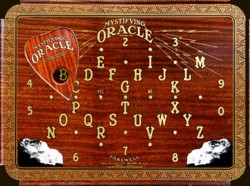
'Electric Mystifying Oracle'
Fuld would manufacture Ouija boards for 26 years, along with other various toys. In February of 1927, it is said that Fuld went to the roof of his Harford Street factory in Baltimore, to supervise the replacement of a flagpole. When a support post gave way, he fell backwards to his death. (Some accounts said it was an accident, others said suicide.) Fuld's children took things over. In addition to continuing production of the Ouija, they marketed Ouija versions of their own that included the Art Deco inspired 'Electric Mystifying Oracle' which would be quite a rare find today. Then in 1966, the Fuld kids retired and sold the whole deal to Parker Brothers, who still produce the Ouija board today. However, in 1999 Parker Brothers stopped production of the classic board and switched to a smaller less detailed "glow in the dark" version that sells now.
Oh, I almost forgot another piece of the story. The naming of the board. There are also differing stories on how the Ouija name was arrived at. Some say that Charles Kennard learned the name while using the board. He said it was an ancient Egyptian word that means 'good luck'. Others say that Fuld came up with the name by combining the French and German words for 'yes'...this etymology seems to be the more widely accepted version.
(Some early competing spirit boards from left to right: Haskelite's "Mystic Board"; "The Wireless Messenger"; Haskelite's "Mystic Tray")
During the early years of Ouija production, other companies marketed their own versions of talking boards, which spawned several lawsuits by Fuld for copyright infringement. There are still various types of spirit boards on the market.
(More early boards: Gift Craft's "Swami"; "I Do Psycho Ideograph"; Lee's "Magic Marval")
Back in the 1920's there was another Ouija craze, and it spawned a couple of songs. The song below, "WEEGEE WEEGEE TELL ME DO" (c. 1920), and another song from the same year, "OUIJA MINE", by Sam Lewis, Joe Young, and Willy White (c. 1920). I did do some net surfing to try and find some sort of recording of either song, but no luck.
"WEEGEE WEEGEE TELL ME DO"
(Ouija, Ouija Tell Me Do)
Lyric by: William Jerome
Music by: Harry Von Tilzer
There is a game played by nearly every family. Seems to be the thing. Rich and poor folks play this little game to see what future days may bring.
Right across the hall from me...there lives a girlie dear. And when her girlfriends call each night...Why this is what I hear?
Wee Gee, Wee Gee tell me do...Tell me if my loving baby loves me true...Tell me quick and tell me fast is our love to pure and good to really last?
Oh Wee Gee, Wee Gee you know me...I will never tell him don't you see?
Once he used to bring me candy by the box. Now he only calls to have me darn his socks. Is he true, the sly old fox.
Tell me Wee Gee do...do...
This little board is the ruler of the nation now. Some game talk of fun. Right in your own home settles any little row most every home has one.
Old maids love it most to death and play it night and day. And one maid laughed and lost her breath. When she heard one girl say.
Wee Gee Wee Gee tell me do. Are the men who marry girlies always true? Should the supper table wait for the ones who really love to come home late?
Oh Wee Gee Wee Gee should I swear? If up on his coat I found a hair? If your husband is talking in his sleep says "Pearl"...Does it mean a present or some other girl? Is it girl or is it Pearl?
Tell me Wee Gee do...do...
The Ouija design has also found it's way into the materialistic world, with it's trademark logo and board design showing up on musical instruments, jewelry, clothing...I really like that lunch box.
Below are the Ouija designs of today with the common glow in the dark version, and a pink version (don't know when that was introduced). Below those are some examples of other 'spirit boards' being sold these days.
(The four spirit boards pictured starting on the top, starting on the left: "Buffy The Vampire Slayer Conversations With Dead People" board; "The Pathfinder Psychic Talking Board"...On the bottom starting on the left: "The Psychic Circle"; the collectible board "Cryptique")
Am I believer or non-believer in the Ouija, or spirit boards as a whole? I've had some experiences over the years that have raised my eyebrows...nothing that has raised my blood pressure though. I find them interesting as I do most things that deal with the 'great beyond'. I will be getting my Ouija board soon. Do I plan on trying it out? If I do, I definitely don't plan on trying it solo. Whether one thinks the Ouija board a portal of evil, or just a neutral means to communicate with the spirit world, solo sessions are just not advisable. If I do 'take it out for a drive', I will most assuredly share it on here. My jury is still out though...
(If you are interested in checking out the boards I mentioned in this post for yourself, you can find links to them along with a few others on the Amazon.com page. Just click on Amazon.com at the top of this blog page.)


 As with 'mediums' on the whole, physical mediums are the conduit of communication between the living and the dead. You have mediums whose gifts manifest on more of a mental line, communicating through methods such as channeling. Successful links with the spiritual are expressed verbally, through writing, etc. Physical mediums contact is exhibited through more "physical" means separate from their actual bodies. Disembodied voices, knocks, raps, the materialization of spirits, objects moving, apports (paranormal materialization of an object), and even levitation. I used the term "conduit" before. The medium can almost be described as a battery that a spirit uses as a power source for manifesting. After a 'true' session or seance, it can take hours or even a couple of days for a medium to recover from one of these energy drains.