Showing posts with label Crystals and Stones. Show all posts

Thursday, July 12, 2012

The Ruby...


Since my birthday falls at the end of this month, I figured I would start off some new additions to my postings on crystals and gemstones with July’s birthstone, the Ruby. I think a lot of people automatically associate it with the glittering kicks Dorothy wears in ‘The Wizard of Oz’.  Baum made a good choice when he penned the book, as the Ruby is a very rare gem much like the rare footwear.

A variety of the mineral corundum (a.k.a. aluminum oxide), rubies are one of the hardest minerals on the planet. On the Mohs scale (1 thru 10, 10 being the hardest), they fall at 9, second in hardness to the diamond. In its pure form, corundum is colorless. It’s the presence of various elements like iron, chrome, and titanium that give the stone its color. Chromium (chrome) is the main element that gives the deep red color to the ruby (all other corundum colors are sapphires). Also, like the diamond, rubies are graded under the “4-C’s”:  color, cut, clarity, and carat weight.

The name ‘ruby’ comes from the Latin word ‘ruber’ which means red. The relationship between rubies and sapphires has only been known since the beginning of the 19th century. Before then, deep red spinels and garnets were also thought to be rubies. Some famous pieces of the British Crown Jewels (the ‘Timur Ruby’, and the ‘Black Ruby’) are in fact spinels. Personally, I have always gravitated towards garnets. They are kind of the ‘poor man’s’ ruby.

(Left: Timur Ruby; Right: Black Ruby)
It is extremely rare to find a ruby that has fine color and good clarity. Interestingly enough, chrome is the culprit. Over the millions of years it took for the stones to develop, chrome was not only giving the developing gems their color,  it was creating multitudes of cracks and fissures. To find a ruby more than 3 carats is not only rare, its price would surpass the cost of a diamond of the same size.  The ‘silk of the ruby’ is a term used for the shiny quality of many rubies. The ‘silk’ effect is caused by very fine needles of rutile within the stone. If a trained eye doesn’t find rutiles within a stone, chances are good that it has been treated and/or is fake.


Some examples of the high price tag on quality rubies, are some jewelry pieces sold at Christie’s auction house around September, of 2011. A number of pieces from Liz Taylor's jewelry collection were auctioned. The ruby and diamond ring pictured above, broke the price-per-carat record for rubies, at $512,925 per carat (the grand total was $4.2 million). The necklace pictured sold for $3.7 million.

(Ruby mine, Mong Hsu)
As I was reading up on this stone, some sources said that India was long thought to be the country of origin for the ruby. Most of the mining background I found centered on Myanmar (Burma). Burmese rubies are thought to be the top of the heap when it comes to high quality. In the 1990’s, a mine in the small town of Mong Hsu, in NE Myanmar, became a primary mining source for the red stones. Historically, rubies and sapphires have also been mined in Cambodia, India, and Thailand, to name a few. After the second world war, some deposits were found in Madagascar, Vietnam, and Nepal. The most recent reported deposits I found were in Kenya and Greenland.


Now for the aspects of stones that I find most interesting. The symbolism. The ruby is represented in the elements of fire and blood. Red. The color of love and passion. The ruby brings and fosters love, as well as bringing one courage and loyalty. It is a stone of nobility, bringing its owner strength and vitality. It encourages one to follow their bliss.

The ruby aids in the reduction of negativity, preserving both the mental and physical health of the wearer. It is worn as a talisman of protection.  When set in gold it is said to carry the masculine energies of the sun, and when set in silver it is said to carry the feminine energies of the moon. The ruby fosters a positive state of mind. It promotes mental clarity and positive dreams. It also aids in obtaining wealth and passion.

There are a number of old beliefs about the stone. In the middle ages, the ruby was thought to be a stone of prophecy. If the stone darkened, it was said to signal that danger was near. It was used in powder form in the 13th century, to cure liver ailments. In the 15th and 16th centuries, it was thought to counteract poison. Rubbing a ruby on the skin was believed to restore a person’s vitality and youth. Rubies were believed to detoxify the system; treat fevers; cure ailments to the circulatory system; stimulate the kidneys, reproductive organs, and spleen.

(Left: Root Chakra; Right: Heart Chakra)
One use/association of the ruby that I was already familiar with, is its resonance to the ‘Base’ (1st) and ‘Heart’ (4th) Chakras. The ‘Base’ Chakra is located at the base of the spine, and is associated with the color red. It relates to the physical body, and is the Chakra that controls our grounding to the Earth. The ‘Heart’ Chakra is located at the center of the chest, and is associated with the color green. The “bridge” between the upper and lower Chakras, it is the love center. It deals with acceptance, compassion, and transformation. (To learn more about all of the Chakras, you can find other posts in the 'Chakra' section under 'Labels'.) 


Monday, October 3, 2011

Bloodstone...

Since we have started into the month of October and can see All Hallows in the distance, I picked a stone for this post that has a name that fits the spirit of the coming season:  Bloodstone.

No, not THAT blood stone, the GEM stone Bloodstone.  (Above is a still from the Full Moon Productions film 'Bloodstone: Subspecies II'; it's the second film of a trilogy, and if you are like me and dig cheesy films, they are definitely for you.)
(Bloodstone) 
A birthstone for March, Bloodstone is dark green with red spots. A form of Chalcedony, it is an unusual variety of quarts created in rock formation rather than in crystal points.  It also goes by the name Heliotrope.  However, in ancient times there was a bit of disagreement among ancient writers as to whether Bloodstone and Heliotrope were indeed the same stone.  Some said there is no difference, and that the stone was named Heliotrope because, when put in water, it presented a red reflection that resembled the image of the sun.  The other camp maintained that there is a difference because Heliotrope is a translucent green Chalcedony with crimson spots, and Bloodstone is green Jasper flecked with red.  I don't know if there was any outcome to that argument back then, but these days the stone called Bloodstone is also known as the stone Heliotrope.
(Left: rough Bloodstone; Right: Bloodstone and Jasper earrings)
Bloodstone is mined, and can be found in Australia, Brazil, China, India, and the US, India being the main source for the stone.  (In India, Bloodstone is said to actually be finely pulverized and administered as both medicine and an aphrodisiac.)  It is a popular stone for jewelry making, and is very affordable.

(Bloodstone beaded rosary)
There is a legend surrounding Bloodstone that dates back to the Middle Ages.  It was believed the stone has special powers as the spots were believed to be the blood of Christ.  The legend states that the stone was created when Christ's blood dripped on the green of the earth at the foot of the cross, it solidified thus creating the stone.  It was given the name "Martyr's Stone", and was used by sculptors when making representations of Crucifixions and martyrdom.


In ancient days, it was believed to aid in overcoming enemies, opening locked doors, and breaking down barriers.  Bloodstone was carried by soldiers to avoid being wounded, and it came to be known as the stone of courage.  Also, women wore the stone to ensure a safe pregnancy and easy birthing.


There are a number of other properties Bloodstone is said to have.  With just a touch it is said to stop hemorrhages, especially nosebleeds.  Bloodstone strengthens the blood, and the circulatory system.  It relieves stomach pain.


Need to align your energy centers?  Bloodstone is your stone.  It can be used to improve the circulation of energy through the body, and remove energy blocks.  To increase the flow of life energy in your home, place several pieces of Bloodstone throughout.  It is said to bring success in business, and attract money.  Keep a stone in your wallet for good luck, to attract money, and for overall good health.
(Left: Bloodstone Runes; Right: Bloodstone dowsing pendulum)
Use it to help facilitate communications with the spirit world.  Engraved with a bat, Bloodstone can be used as a talisman to enhance the effectiveness of spells and rituals.
(Left: Heart Chakra symbol; Right: Root Chakra symbol)
Meditating with Bloodstone connects the Heart Chakra with Root Chakra energies.  This is an advisable thing to do before starting any new venture.  Acting primarily with the Root Chakra, Bloodstone helps with decision making and unselfishness.  It can help improve talents and creativity.  The stone aids in purifying the blood, and can balance blood flow throughout the body.  It also helps with failing eye sight.

Sunday, September 11, 2011

Stone Tiger's Eye...


(Tiger's Eye marbles)


Filled with layer after layer of rich browns, varying shades of yellow from lemon to honey, and hints of red, Tiger's Eye shows continual pattern variety from stone to stone.


('Rough' example of Tiger Eye)

It is a member of the quartz family, and is a part of the quartz group known as chalcedony's (made up of micro-crystalline or crypto-crystalline structures; variety of quartz whose crystalline makeup is only seen through high magnification).  It is primarily mined in south Africa and Australia, but it can also be found in India, Burma, China, Brazil, Spain, and the US.  (Some other interesting notes on quartz: it is any type of stone that is oxidized; quartz makes up 12% of the Earth's crust.)


I have always loved Tiger's Eye, and have had a number of jewelry pieces with stones inset/inlaid.  Jewelry is the most popular use of Tiger's Eye, but it also has a number of metaphysically based uses.


(Australian Tiger Iron)

Before I get to some of those I want to mention 'Tiger Iron', a multi-layered stone that is related to Tiger's Eye.  Tiger Iron is made up of Tiger's Eye, red Jasper, and black Hematite.  From the information I read on it, it looks like Australia is the chief producer of Tiger Iron.  It's quite beautiful.


(Tiger Eye Worry Stone, with triple moon design)

Now to the more metaphysical properties of Tiger's Eye.  It is the planetary stone for Gemini.   It is used as a talisman to protect from evil and illness. Need to make some changes in your life? Hold it for focus and grounding. This stone will help you to be practical, and it helps bring order from chaos. The beautiful warm gold of the stone signifies the ability to manifest, and the deep rich browns represent the energies of the Earth.  Thus the Tiger's Eye helps translate ideas into physical reality.

Tiger's Eye is said to be beneficial to the over all health and spiritual well being of the wearer.  Some specific healing effects are to night vision, to general wounds and bruises, various ailments of the digestive tract, and it is said to alleviate pain.


(Solar plexus Chakra)

The Chakra most closely associated with Tiger's eye is the Solar Plexus Chakra.  The soothing gold resonance of the stone works with the yellow of the Chakra to balance mind, body, and spirit.  When placed in the area of the solar plexus, tiger's eye stones can help release mental blocks and ease stress.  It can promote clarity of the mind.  It is also said to shield the aura from negativity.  Tiger's Eye imbues the wearer with the traits of the tiger:  courage, strength, agility, nobility.


Wednesday, September 7, 2011

The Garnet...

(Clean, but rough cut, garnets) 

Another stone that ranks high on my favorites list is the garnet.  Shimmering drops that resemble the blood red seeds of the pomegranate.  I have always seen them as the poor man's ruby.  My birthstone is the ruby (July), but I prefer the deeper red of the garnet (January).  Garnets are a much more affordable replacement to the Ruby, which definitely made a difference when I dabbled in jewelry making.

(Little Pine garnet mine in North Carolina)

Garnets can be found in countries all over the world...the US, Australia, south Africa, and Scotland, to name a few.  Actually, garnets come in a variety of colors, not just red.   They can be found in all of the colors of the rainbow. Well, I did encounter a bit of an argument surrounding the color blue.  Some say that no garnets have been found in the shade of blue, and others say that they do exist (apparently, the first reported blue garnet find was in Madagascar in the early 1990's), but either way you look at it they are extremely rare.

 (Old/antique example of garnet cloisonne jewelry)

Throughout history, the garnet has been a common ornamental gem, especially the red variety.  A common method was to inlay them in gold using the cloisonne technique (the stones being separated by thin strips of metal.

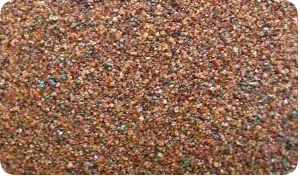
(Garnet sand) 

These stones are also commonly used in sand form for industrial purposes.  Garnet sand is used as media for sand blasting, and garnet 'sand' paper for use in the finishing of wood.  Abundant sources of garnet sand are Australian and Indian beaches.

(Garnet beads) 


Metaphysically, one of the most important properties of the garnet is it's ability to purify.  Their healing capacity is strong, and they remove toxins, and purify bodily energies.  When one thinks of the garnet, I would say that just about everyone would think of the color red right off the bat.  The garnet strengthens and  heals relationships, which makes sense...red is the color most closely associated with love.  It can elevate a relationship to a higher level, and bring a calm and secure clarity to a bond.  The garnet also relates to desire of all kinds.  It can instill strength necessary to make decisions and move forward with life. It can also promote creativity.


(Some of the different colors that garnets are available in)

From a health perspective, Garnets can help in both physical and mental ways.  They promote good health.  It has been long believed that red garnets have a deep effect on the blood, curing diseases of the blood and heart.
(Left:  Root Chakra...Right:  Heart Chakra) 

In terms of the Chakras, The Root and Heart Chakras are linked to the garnet.  The Root Chakra resonates to the color red, and it symbolizes strength and life.  It is the foundation linking us to the physical world (it sits at the bottom of the spine).  The red of the garnet resonates with the red of the Chakra.  As for the Heart Chakra, the garnet aids in aligning the spiritual and the emotional.  Located at the center of the chest, the Heart Chakra deals with the emotional...love, forgiveness, compassion, etc.  Another key way the garnet acts with this Chakra is that the Heart Chakra deals with blood, the circulatory system, and the heart.

(Rough garnet)

To "cleanse" garnets, run them under water for a few minutes to remove negativity.  Then place them on top of several quartz crystals to re-energize.

Saturday, August 27, 2011

Hematite...

 Another stone on my favorites list is hematite...but it's not really a 'stone', it's a form of iron oxide (about 70% iron ore, and 30% oxygen).  


(Ancient hematite mine)

Hematite is a mined mineral that is a primary ingredient of iron.  In geological terms, it can be found in igneous, metamorphic, or sedimentary environments.  It is also "paramagnetic" which means it is slightly attracted to magnetic fields.  Hematite is usually found in areas where there has been water, or volcanic activity.  There have been discoveries of forms of hematite on the planet Mars, which seems to support theories of there once being water there.  


 Hematite comes in a few colors: black to silvery grey, brown, and reddish brown to red.  All color variations have red veining in them.  The most common color is silvery grey, as it is used widely in the creation of jewelry.  It's quite beautiful in its polished state, and its metallic appearance does give one the impression that it is something other than your usual stone.
From a metaphysical perspective, hematite is seen as a grounding stone.  It's a healing stone.  Want to develop some mental clarity, or get 'centered'?  Than this is the stone for you.  It is the 'stone' of life energy, and projects an energy of will power and confidence.  Use it to project negativity away, and to bring energy back to the self to generate that energy within and get centered.  It assists in bringing awareness back to the self.   Hematite is also used in the meditative practice of astral projection.  Hematite is a plentiful mineral, and can be found in the US, Canada, and Brazil.


A note to those who own hematite pieces in the shape of stones for meditative purposes, etc., do not wash them in water.  To cleanse/re-energize your 'stones', place them on top of quartz crystals for several hours to a full day.


(Left:  Root Chakra; Right:  Solar Plexis Chakra) 


Hematite is another stone that has a link to the Chakra system, mainly the root Chakra located at the base of the spine.  Some of the emotional issues associated with this Chakra are self esteem, security and survival.  Hematite partners well with the root Chakra due to its grounding nature.  Hematite helps to align the energies of the mind, body, and spirit.


The solar plexus Chakra also works with the energies of hematite.  Some of the emotional issues linked to this Chakra are self esteem, self image fears, and indecisiveness.  It governs the sense of self within the universe, and personal power.


(Set of Rune Stones made out of hematite...I have some of these)

Wednesday, August 24, 2011

The Amethyst...


Today...for some reason...a necklace I own came to mind.  The pendant is of an abstract design, is made of sterling, and has amethyst stones mounted in it.  There are two small pieces, pyramidal in shape, and a small flat...well, the best way I can describe it would be to call it a 'slice'.  A slab from a rather small amethyst geode, the cluster section of small points intact.  That's a photo of it below...

(I purchased this necklace from one of my favorite stores, 'The Psychic Eye' in Sherman Oaks, CA...I would love to visit there now, but it's a hell of a commute from Savannah...  They always have some really unique jewelry.  If you are in that neighborhood and haven't been, 
I encourage you to check it out.)) 

My necklace has inspired me to create some posts relating to some of my favorite crystals, and a few other metaphysical  items/talismans.

(Sections of Amethyst geodes.) 

Amethyst is one of my favorite stones.  Not just for its beauty, but for its energies.  SiO2 (amethyst) is one of many forms of quarts.  It is light to deep purple/violet.  It is found in round rocks of varying sizes and shapes which are called geodes.  When you break one of these rocks open, you will find the crystalline world of the amethyst inside.

(Entrance to an amethyst mine in Argentina.) 

Geodes are found in mines.  Brazil (among others) has many amethyst mines, and there are a number of states in the US that also have large deposits of amethyst (Arizona, North Carolina, Pennsylvania, to name a few).  Several centuries ago, amethyst was on the 'expensive stone' lists along with rubies, diamonds, etc.  Once amethyst was found to be a rather abundant stone, it's value decreased considerably.  However, over the years I have seen some huge amethyst geodes for sale at jewelry shows, and they were not cheap.  They were breathtakingly beautiful though.

(A large Amethyst geode.  This one is pretty big, but I have seen bigger.  
I love the color of this one.) 

Now for the more spiritual side of this purple crystal.  Amethyst is a stone of spirituality, enlightenment, and protection.  Its energies make it ideal for meditation.  It creates a connection between the Earth plane, and otherworldly planes.  A calming influence, it brings peace, releases negativity.


Although a number of different stones are used, amethyst is used in the creation of dowsing pendulums.  I think that most people think about the location of water below ground when they hear the word "dowsing".  Those types of dowsers come in two common designs: one looks kind of like a big wishbone and is fashioned from twigs/branches, and the other is in the form of two free moving metal rods that cross when the dowser approaches their target.


'Dowsing pendulums' are smaller, and generally used for more specific Q&A sessions.  They come in a variety of designs, one that is pictured above...that particular one has an amethyst sphere on it.  The diviner holds the end of the chain between the index finger and thumb of one hand, lifts it up so that the pendulum dangles down, and keeps the pendulum as still as possible.  When concentration starts and the questions are asked, the diviner gets their answers from the movement of the pendulum.  I have a small one (sans crystal) that I have used upon occasion, and it's a fascinating tool.


Amethyst wands (large points, or the crystal fashioned into points) have been used for centuries for healing purposes.  The stones energies are focused on an ailing person to draw the negativity/sickness out of them.  Then the crystal is turned away from them, so the negative vibes can be released.


Back on January 23rd of this year, I posted a blog entry about 'Chakras' called "Shirley & Chakras".  The seven Chakras, or spinning wheels, all resonate to certain colors.  The Crown Chakra relates to spiritual awareness and the self.  It is located at the top of the forehead, above/between the eyes.  (Right around the area where you will find the pineal gland.)  This very spiritual Chakra resonates in the color purple.  Amethyst is known as the Crown Chakra Crystal.  Having aligned Chakras is a preferred state to be in.  *grin*  Amethyst is a great help to the aligning of the Chakras.  Stress reducer, cleanser...it helps to open up the spaces between spiritual channels.  It also is a booster of creativity.  (If you want to read about the different specifics for each Chakra, I created a clickable link where it says "Shirley & Chakras" above.)


Some background on the beautiful amethyst...