Showing posts with label Chakras. Show all posts

Thursday, July 12, 2012

The Ruby...


Since my birthday falls at the end of this month, I figured I would start off some new additions to my postings on crystals and gemstones with July’s birthstone, the Ruby. I think a lot of people automatically associate it with the glittering kicks Dorothy wears in ‘The Wizard of Oz’.  Baum made a good choice when he penned the book, as the Ruby is a very rare gem much like the rare footwear.

A variety of the mineral corundum (a.k.a. aluminum oxide), rubies are one of the hardest minerals on the planet. On the Mohs scale (1 thru 10, 10 being the hardest), they fall at 9, second in hardness to the diamond. In its pure form, corundum is colorless. It’s the presence of various elements like iron, chrome, and titanium that give the stone its color. Chromium (chrome) is the main element that gives the deep red color to the ruby (all other corundum colors are sapphires). Also, like the diamond, rubies are graded under the “4-C’s”:  color, cut, clarity, and carat weight.

The name ‘ruby’ comes from the Latin word ‘ruber’ which means red. The relationship between rubies and sapphires has only been known since the beginning of the 19th century. Before then, deep red spinels and garnets were also thought to be rubies. Some famous pieces of the British Crown Jewels (the ‘Timur Ruby’, and the ‘Black Ruby’) are in fact spinels. Personally, I have always gravitated towards garnets. They are kind of the ‘poor man’s’ ruby.

(Left: Timur Ruby; Right: Black Ruby)
It is extremely rare to find a ruby that has fine color and good clarity. Interestingly enough, chrome is the culprit. Over the millions of years it took for the stones to develop, chrome was not only giving the developing gems their color,  it was creating multitudes of cracks and fissures. To find a ruby more than 3 carats is not only rare, its price would surpass the cost of a diamond of the same size.  The ‘silk of the ruby’ is a term used for the shiny quality of many rubies. The ‘silk’ effect is caused by very fine needles of rutile within the stone. If a trained eye doesn’t find rutiles within a stone, chances are good that it has been treated and/or is fake.


Some examples of the high price tag on quality rubies, are some jewelry pieces sold at Christie’s auction house around September, of 2011. A number of pieces from Liz Taylor's jewelry collection were auctioned. The ruby and diamond ring pictured above, broke the price-per-carat record for rubies, at $512,925 per carat (the grand total was $4.2 million). The necklace pictured sold for $3.7 million.

(Ruby mine, Mong Hsu)
As I was reading up on this stone, some sources said that India was long thought to be the country of origin for the ruby. Most of the mining background I found centered on Myanmar (Burma). Burmese rubies are thought to be the top of the heap when it comes to high quality. In the 1990’s, a mine in the small town of Mong Hsu, in NE Myanmar, became a primary mining source for the red stones. Historically, rubies and sapphires have also been mined in Cambodia, India, and Thailand, to name a few. After the second world war, some deposits were found in Madagascar, Vietnam, and Nepal. The most recent reported deposits I found were in Kenya and Greenland.


Now for the aspects of stones that I find most interesting. The symbolism. The ruby is represented in the elements of fire and blood. Red. The color of love and passion. The ruby brings and fosters love, as well as bringing one courage and loyalty. It is a stone of nobility, bringing its owner strength and vitality. It encourages one to follow their bliss.

The ruby aids in the reduction of negativity, preserving both the mental and physical health of the wearer. It is worn as a talisman of protection.  When set in gold it is said to carry the masculine energies of the sun, and when set in silver it is said to carry the feminine energies of the moon. The ruby fosters a positive state of mind. It promotes mental clarity and positive dreams. It also aids in obtaining wealth and passion.

There are a number of old beliefs about the stone. In the middle ages, the ruby was thought to be a stone of prophecy. If the stone darkened, it was said to signal that danger was near. It was used in powder form in the 13th century, to cure liver ailments. In the 15th and 16th centuries, it was thought to counteract poison. Rubbing a ruby on the skin was believed to restore a person’s vitality and youth. Rubies were believed to detoxify the system; treat fevers; cure ailments to the circulatory system; stimulate the kidneys, reproductive organs, and spleen.

(Left: Root Chakra; Right: Heart Chakra)
One use/association of the ruby that I was already familiar with, is its resonance to the ‘Base’ (1st) and ‘Heart’ (4th) Chakras. The ‘Base’ Chakra is located at the base of the spine, and is associated with the color red. It relates to the physical body, and is the Chakra that controls our grounding to the Earth. The ‘Heart’ Chakra is located at the center of the chest, and is associated with the color green. The “bridge” between the upper and lower Chakras, it is the love center. It deals with acceptance, compassion, and transformation. (To learn more about all of the Chakras, you can find other posts in the 'Chakra' section under 'Labels'.) 


Thursday, May 31, 2012

The Lotus & The Water Lily...

("Water Lilies", by Claude Monet, c. 1906)
(White Lotus Flower, hand painted on silk;
Artist:  Lin Wei)
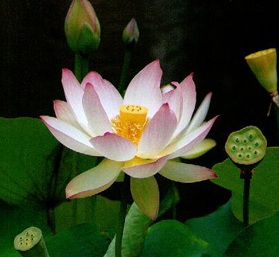
The Lotus.  Beautiful, yet slightly alien in appearance (due to the pollen producing seed pod in the flowers' center that resembles a shower head). An aquatic plant whose many petaled blooms rise above the surface of murky ponds, it's wide leaves also rising above the water.  A robust and aggressive plant, it has an ever so slightly similar appearance to another water growing plant.  A wide leaved plant that also has many petaled blooms.  The Water Lily.

While looking up some photographs of Lotus flowers on Google Images, I noticed the pictures of Water Lilies mixed in.  People mistakenly think that Lotus flowers are also Water Lilies, but the two flowers aren't related.  They are not even distant cousins.  Knowing that they are quite different wasn't enough.  As often happens with me, I was moved to look at the specifics surrounding the comparison of the two.


As you can see by the above illustration, their anatomy is quite different. However, they both do have two attributes that are pretty much universal among most flowers:  Petals, and stamens.  They both grow in fresh water, are both perennials (meaning they can live more than two years; thrive in the Spring and Summer, and then in the Autumn/Winter months they lose their leaves and blooms, to regrow and bloom in the next season), and they both like the murky and muddy waters of ponds, growing their roots securely into the muddy bottom.

(Water Lilies)
I will start with the unique qualities of the Water Lily, as I have a lot more to write about the Lotus.  If you ask most people what a Water Lilly looks like, they will probably say 'a white flower that grows on top of the water, and has big flat leaves that frogs like to rest on upon occasion'.  They would be right, except that Water Lilies are commonly pink or white.  The blooms sit on, or very close to, the surface of the water.  The leaves that frogs like to sit on are appropriately called 'pads' because of their wide, flat appearance, and the way they lie flat on the water's surface.
(2-month old baby on giant lily pad)

Water Lilies can be found in the eastern regions of North America, Canada, and are native to the Amazon.  South America boasts what is described as a "giant" variety of Water Lily (called Victoria), that has leaves so huge and sturdy that a person is said to be able to sit on them (or a two-month old baby).  These huge Lilies also only bloom at night, the blooms having a thorny underside.

The Lotus and the Water Lily both grow seed pods.   The Water Lily pods grow once the blooms are spent.  A capsule shaped growth housing the 'fruit' or seeds develops.  With the Lily, pollination is not required for it to grow, so they can quickly over-take a pond.

(Left:  Water Lily seed pod, Photo:  Michael R. Martin;
Right:  Lotus seed pod;  Middle:  Dried Lotus seed pods)
The Lotus seed pods grow on separate stalks from the flowers.  The flowers' pollen pollinates the seed pods.  Like the Lily, Lotus plants are very aggressive. When adding either plant to your own pond, it is advisable to keep the plants in submerged pots so they don't go too crazy.

Many parts of the Lotus and Lily plants are edible.  The flowers, young leaves, and rhizomes (an underground stem that grows horizontally, and sends out shoots and roots) are all edible.

(Lotus flower and seed pods)
Lotus seeds are edible, can be eaten raw, or dried and popped like popcorn. (If the dried seed pods look familiar, they are a very common component of dried flower arrangements.)  All of the Lotus' parts are used in various Asian cuisines, and the roots are used in the making of traditional herbal medicines. The flower stamens are dried for the making of tea.  (It is recommended to not eat Lotus plants raw, as there is a danger of parasite transmission.)

(Dried and "popped" Lotus
seeds)
Where the Water Lily stays low to the water, the Lotus does the opposite.  It's disc-shaped leaves grow above the water, and can grow as large as 35" in diameter.  It's blooms are larger than the Lily, and also grow upwards, reaching a distance above the water surface of anywhere from 3 to five meters.  They are indigenous to southern Asia, and Australia.

The rounded seeds of the Lotus are considered to be the oldest viable seeds in the world.  Seeds found in China were tested through the process of carbon dating.  Their age was said to be as old as 1,288 years, give or take 200 years. The seeds were successfully germinated in March of 1994, and are still growing.

The unrelated flowers are not so different after all. With so many similarities, it's interesting that these two flowering water plants are not from the same family.  It is obviously their similarities that add to peoples confusion.  Having satisfied my questions about the relationship, or lack thereof, between the Lotus and the Water Lily, I'm going to move on to the symbolic side of the Lotus flower, one of my favorite blooms.


The Lotus holds great significance in both Buddhism and Hinduism, and it was highly regarded by the ancient Egyptians.

THE EGYPTIANS

The ancient Egyptians looked on the Lotus as a symbol of creation/birth, and the Sun.  The Sun disappeared at night, and the Lotus was said to close and sink into the water until the next day when it would rise and reopen.  (I wasn't able to find much information to corroborate the act of closing and sinking under the water.  Lotus flowers slowly emerge and bloom over a three-day period. Then they open in the morning, and close in the evening.)  The Lotus also was associated with death, the "Book of the Dead" holding spells that were supposed to transform people into a Lotus, allowing them to be reborn/resurrected.

White and blue were the most common colors, and pink Lotus flowers were introduced during the late period of the civilization.  The blue Lotus was most commonly portrayed in hieroglyphics.  It was an integral part of the symbol for the unification of the two Egyptian Kingdoms.   The Lotus represented upper Egypt, and the Papyrus represented lower Egypt.  The two flowers being inter-woven, came to be the symbol for the bringing together of the two kingdoms.


HINDUISM

(Lakshmi)
The Lotus symbolizes many things to the Hindu.  Some of it's strongest associations are with beauty, and purity.  It also represents fertility, prosperity, spiritualism, and eternity.  The white Lotus is most commonly represented, with many Gods and Goddesses being linked to it.  A couple of examples follow:

The Goddess Lakshmi appears atop a fully open Lotus (either standing or sitting). Consort to the God Vishnu, she is the Goddess of material and spiritual prosperity, wealth, fortune, and beauty. Her usual depiction shows her bestowing the coins of prosperity, flanked by elephants signifying royal power.  The Lotus symbolizes the fertile growth of all organic life, as the world is continually reborn on the Lotus which grows from Vishnu's navel.

The God of creation, Brahma, is usually depicted emerging from the Lotus that crawls from Vishnu's navel.  Brahma is the father of Manu, from which all humans are descended.  Brahma is said to be self-born in the Lotus.

(Brahma emerging from the navel of Vishnu on the Lotus, Lakshmi at Vishnu's feet)
The Lotus can emerge clean and pure from muddy waters. It represents wisdom and spiritual enlightenment.  The charity in a person who wants nothing in return.  The unopened bud of a Lotus represents a folded soul, that can unfold and open itself to the divine truth.


BUDDHISM

The lotus means many things to Buddhists, who share a few of the same basic beliefs with the Hindus.  The symbology is quite similar.  First, there are the six colors of Lotus that represent different things to Buddhists:


  • White:     Purity, the spirit, and the mind.  It symbolizes Bodhi (being awakened), and represents mental purity, and spiritual perfection.  Considered to be the womb of the world.
  • Red:        Represents love, and compassion.  Related to the heart.
  • Blue:       Represents common sense; the uses of logic and wisdom to create enlightenment.  The victory of the spirit over intelligence, knowledge, and wisdom.  
  • Pink:       Represents the history and legends of Buddha.  The true Lotus of Buddha.  The Supreme Lotus.
  • Purple:    Spirituality, and mysticism.  Associated with the esoteric.  8 Petals:  representative of one of the principal teachings of Buddha, the noble 8-fold path.  Following the path is a self awakening.  One of the noble truths.
  • Gold:      Represents the achievement of all enlightenment, especially in Buddha
The Lotus is associated with faithfulness, purity, and spiritual awakening.  It also represents fortune, and is a symbol of rebirth.  When morning dawns, and the Lotus breaks the water's surface, it a suggestion of desire.  Desire that will lead to spiritual enlightenment.  It lives/grows in muddy water, and rises to bloom above the murk to gain enlightenment.

(Statue of Buddha meditating on a Lotus)
It also symbolizes purification.  The spirit is born into the murk.  For the faithful followers who work to rise above the murkiness, there is a purifying of the spirit.

The stages of the Lotus flowers growth represent different stages of the path to enlightenment.  The closed flower, or bud represents the time before the Buddhist follower found enlightenment.  The fully opened bloom represents full enlightenment, and self-awareness.

People are born into a world where there is suffering, and it is a vital part of the human experience.  It strengthens us, and we learn from it.  It teaches us to resist evil. When evil is banished from our mind, we can break free of the murk and mire to become one with Buddha.  It shows us who we are.  We learn to choose the right path, and not the easier one.

The Lotus represents rebirth.  It represents a reincarnation.  The soul leaves this world in its' present form to be reborn in another.


(Symbol and color for the 7th Chakra)
The Lotus is associated with the 7th, or Crown Chakra.  Called the "Thousand Petal Lotus" by many, the Crown Chakra is our connection to the divine, to the light from above.  By meditating on the Kundalini it rises through the 7 energy centers or Chakras along the path of the spine, creating an awakening and spiritual experience at each center.  When it reaches the Crown Chakra, the most profound of mystical experiences can be achieved.

Thursday, October 6, 2011

Sandalwood...


Relaxing is something I love to do, yet don't do nearly enough.  For the times that I do need to engage in some stress relief and relaxation, there are certain things I like to use to help create a proper atmosphere.  Candles are one (pine or cedar scents, preferably), and incense is another.  I have burned incense for years.  My favorite scent?  Sandalwood, by far.  It creates such a sense of peace, and motivates me creatively.  Sandalwood is also used for protection, and is quite useful in ridding a space of negativity.  It is a handy thing to have around.
Sandalwood is...well, a wood, so it would stand to reason that Sandalwood comes from trees.  There is an ancient Buddhist Scripture, the Moho chi-kuan, that states, "None but the Mali Mountains contain Sandalwood."  We can safely say that that is not the case, but it is known that Sandalwood is one of the oldest incense materials, dating back at least 4,000 years.

(Marayoor, South India ~ the only place in Kerala where there is natural growth
of Sandalwood trees)
(Sandalwood tree)
(Sandalwood)
It is a fragrant wood.  Yellow, fine grained, and heavy, once cut it can retain it's scent for decades.  A slow growing tree of medium size, it is 'hemiparasitic' which means that like mistletoe, it gets some nourishment from a host plant.  However, Sandalwood is a little different in that it also photosynthesizes.  It can live either way.  The wood and essential oils produced from the tree are in very high demand these days, which has caused widespread over-harvesting.

Many countries grow Sandalwood:  Australia, Indonesia, the Pacific Islands, Sri Lanka, and a chief producer is Southern India.  Indian Sandalwood (Santalum Album) is indigenous to Southern India, and looks to be the most sought after. It is also endangered.  The trees are owned by the government who try to monitor the harvesting of the trees, but illegal tree chopping is a huge problem, many trees getting the axe well before their time. One source said that Sandalwood is not commercially valuable until it's at least 8 years old. Another source said that trees are being harvested at age 14, before they are mature. Going by both accounts, it sounds like Sandalwood is commercially valuable well before it has fully matured which is creating a problem with tree crops, and even though some harvesters are waiting until the trees are 14 to cut them, they are still not fully mature...and none of that really matters anyway because shady tree thieves are sneaking in and cutting down trees illegally no matter how old they are.  The bottom line is that prices are ever increasing because legally harvested supply can't meet demand.  It's all such a shame. The thought of a possible future world without Sandalwood...I think I will move on from the sad stuff.
(Quandong fruit)
Australia also produces quite a bit of Sandalwood.  Australian Aborigines eat the seed kernels, nuts, and fruit of local trees, such as the Quandong, one of two Australian Sandalwood trees.  It is a smaller tree of the Sandalwood family.
(Essential Oils)

In addition to the wood of the Sandalwood tree, there is also the production of essential oils from the tree's bark, and also from the heartwood which is the most precious part of the tree.  These days the oil is extracted by a steam distillation method.  Super heated steam is passed through powdered wood. Steam helps unlock and carry away the oil held within the cellular structure of the wood. Once the steam is cooled, you are left with hydrosols (a.k.a. floral waters) and essential oil.


(Old drawing of essential oil distillery)
The traditional method of extraction is hydro-distillation.  Although rare these days, this method is said to yield an oil with a superior aroma.  The wood powder is allowed to soak in water in a hydro-distiller.  A fire underneath the reservoir/vessel heats the water, and carries off steam which is allowed to cool.  The Sandalwood oil is removed from the top of the hydrosol.

(Sandalwood Essential oil)
An Australian Sandalwood tree known as Santalum Spicatum, produces a heavier concentration of essential oil, and is most used by perfumers and aromatherapists.  In the 1840's, Sandalwood was Western Australia's biggest export.  The first oil to be distilled was in 1875, and by the turn of the century Australian essential oil was intermittently produced.  Of course, today production is much higher and it is highly sought after for it's woody and warm aroma.

(Ganesh Aarti)
Now, onto some of the spiritual and metaphysical uses of Sandalwood.  Hinduism uses Sandalwood in a paste form as an integral part of spiritual ceremonies and rituals.  Used to decorate the icons of deities and to mark religious utensils, preparation of the paste is only done by Priests to retain the purity.  Religious devotees apply it to the forehead, or neck and chest.  It is used as an alternative medicine to bring the taker closer to the divine.

(Hindu Priest making Chandan)
The steps in making the paste are to grind Sandalwood by hand on granite slabs that are specially designed for that purpose.  Next, water is added until a thick paste is formed.  It is then mixed with saffron to create 'Chandan', or Sandalwood paste.
(Different types of Sandalwood Incense ~ from right to left:  stick incense, coil incense, and a type of
cup incense that I had not seen before)

(Amitabha Buddha)


(Padma Lotus)
Attributed to the Amitabha Buddha, Sandalwood is considered to be a part of the padma, or lotus group.  It is believed to transform the individuals desires and maintain alertness during meditation.  Sandalwood is one of the more popular scents when presenting an offering to Buddha.


(Sandalwood chips)
In either a chipped or powdered form, Sandalwood is used in the creation of talismans.  It works with the energies of the Moon, and is very powerful when burned and worn during Full Moon rituals.  For spiritual purification and cleansing, mix it with Frankincense.  Sandalwood enhances both spiritual and physical well being.  It has the highest vibration levels of any essential oil that resonates with aspects of our individual selves.  It attracts the highest spiritual vibrations, opens the highest spiritual centers, and aligns the Chakras to enhance spiritual awareness and allow healing energies to flow.  Sandalwood is an enhancer of receptivity and assists us when contacting our Guardian Angels, and our higher selves.  To focus the mind, help the dream state, or promote visions, place some oil in the center of the forehead.  Sandalwood is associated with protection, banishing negativity, meditation, and astral projection.
(The Chakra System)
Sandalwood has uses beyond the spiritual and metaphysical.  The wood is also used for carving, which it is well suited for.  The oils are used to make soaps.

(Sandalwood Soap)

(Antique carved Sandalwood box)

Personally, I enjoy all Sandalwood incense variations, but I really like the Japanese Morning Star brand.  The sticks are small, burn completely to ash, and each box of incense comes with a little ceramic tile with a hole in the center ~ an incense burner.  Also, the aroma is really nice.  Over the years I have been known to burn white candles and Sandalwood Incense to dispel negativity.  Only positive vibes for me.  In my post entitled 'Spirited' where I relate a Table Tipping experience, I talk about my usage of candles and incense to cleanse my apartment.  The environment created is so peaceful, and energizing at the same time.  Perfect for meditating.